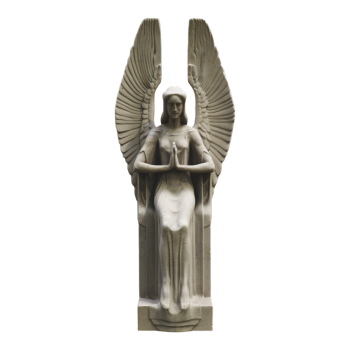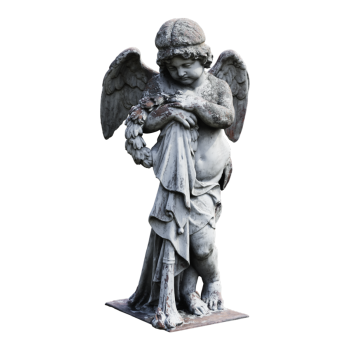

Angel stone carving holding wreath at Vienna Central Cemetery

Angel stone carving holding wreath at Vienna Central Cemetery

Nepal's ancient stone carving eagle

Nepal's ancient stone carving eagle

This sculpture was built by King Maratha in the Kathmandu Valley, however, this Garuda is the largest one in Kathmandu, built in the 17th century near the Maju Deval Narayan temple, and was constructed as part of the palace's surroundings to beautify it.
Statue of Muse Talia

Statue of Muse Talia

Dying Gladiator Stone Carving

Dying Gladiator Stone Carving

This sculpture depicts a dying gladiator who displays elegance and dignity in the face of death, gazing at the crown he has earned for his courage. This sculpture was created by French sculptor Pierre Julien (June 20, 1731- December 17, 1804) and was his second entry into the Royal Academy of Painting and Sculpture. It was a crucial work for him. This sculpture is currently on display at the Louvre Museum in Paris, France.
The Piet à da Palestrina marble statue of the Virgin Mary in Palestrina
The Piet à da Palestrina marble statue of the Virgin Mary in Palestrina

Piet à da Palestrina "is a marble sculpture from the Italian Renaissance period, dating back to around 1555 AD. It is currently on display at the Accademia Gallery in Florence. This sculpture depicts three characters, one of which is the body of Jesus Christ. This sculpture was attributed to Michelangelo's work in the first half of the 18th century.
Portrait statue of a Cypriot man

Portrait statue of a Cypriot man

This statue is a portrait of a man from Cyprus, made around 350 to 250 BC. This statue was discovered in the Apollo Temple and has a height of 50.50 centimeters. It is now on display in the British Museum.
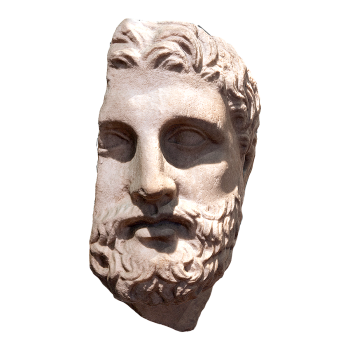
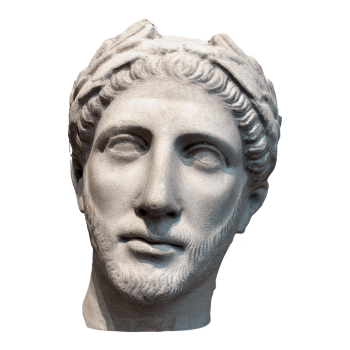
Marble statue of the head of a man with long beard

Marble statue of the head of a man with long beard

This marble statue is the head of a bearded man, possibly representing the ancestors of King Mausollos. This work was discovered around 350 BC in the main sculptural sediment north of the North Peripolis Wall, carved from marble. This statue is now on display at the British Museum.
Lucius relief bust

Lucius relief bust

This Roman stone tomb relief depicts Lucius Antius Philomorsus, his daughter, and his wife. The relief is depicted in the style of the Roman Republic. The production date of this work is from 15 BC to 5 AD, and the dimensions are: height of 61 centimeters, width of 165 centimeters, and depth of 18.5 centimeters. This relief is currently housed in the British Museum.
Creative Ornaments: Four No Little Monks Don't Say Little Shami Statue Ornaments

Creative Ornaments: Four No Little Monks Don't Say Little Shami Statue Ornaments

The kneeling statue of Egyptian Queen Hatshepsut

The kneeling statue of Egyptian Queen Hatshepsut

Hatshepsut (reigned from 1503 BC to 1482 BC). The queen of the 18th Dynasty of Egypt, who reigned for 21 years, passed away, and after her death, Syria and Palestine declared independence (later conquered by Thutmose III). After Thutmose III began to govern alone, he did not immediately begin to eliminate the traces of the governance of Hatshepsut. The related retaliatory actions were only launched in the late period of his reign, when the pharaoh ordered the destruction of many carvings engraved with her name and image.
Gandara relief sculpture

Gandara relief sculpture

This is a Gandhara relief depicting a person riding between the two humps of a camel, holding a sacred object in both hands, with a solemn and sorrowful expression. The person in front turned around to look at the artifact, with the same serious expression on their face. This relief is from the Swat region in the third century AD and is made of gneiss. Gandara art is a Buddhist art form from the Gandara region in the northwest of the Indian subcontinent (now eastern Pakistan and Afghanistan), which reached its peak around the 1st century BC to the 5th century AD.
Front of the house, guarding against evil spirits, stone lion carving - male lion

Front of the house, guarding against evil spirits, stone lion carving - male lion

Front of the house, guarding against evil spirits, stone lion carving - female lion

Front of the house, guarding against evil spirits, stone lion carving - female lion

Chinese Taipei Dalongdong Stone Carving "Bao'an Palace Mother Stone Lion"

Chinese Taipei Dalongdong Stone Carving "Bao'an Palace Mother Stone Lion"

Since ancient times, China has been skilled in using bamboo strips to enrich and express depth and vitality through the interaction of "facial" bamboo strips. In traditional Chinese Han stone carving, this characteristic is most vividly reflected in the mid Qing Dynasty. Taking the stone lion with the inscription "Respected to Emperor Du Youzhang of the Qing Dynasty in the 14th year of the Jiaqing reign" as an example, its cheeks, nose wings, arms, shoulders, and limb trunks can all be seen with "tassels" dividing them, creating a turning point in the moving surface. The ribbon at the foot is also cut at the contour tassel, forming a bright and vigorous face, and conveying the layered and thick body feeling of the ribbon flipping. This pair of stone lions were punished for violating regulations by carving the female lion into an opening due to the craftsman's carelessness, resulting in no salary.
Stone Carving of the Northern Wei Vows Buddha Pagoda during the Northern Wei Dynasty in the 4th Century

Stone Carving of the Northern Wei Vows Buddha Pagoda during the Northern Wei Dynasty in the 4th Century

This Buddhist scripture pillar engraved with sacred Buddhist scriptures belongs to a group of miniature pagodas (scenic pagodas), which are only found in the Gansu Corridor in northwest China. Their age ranges from 426 AD to 36 AD, some of which bear the names of Buddhist donors who entrusted them at home. A pagoda is a circular building built to worship Buddhist relics. Miniature pagodas may be commemorating visits to holy sites or representing donations to religious groups and sites.
Lotus Terrace Thousand Hand Guanyin Stone Carving Sculpture

Lotus Terrace Thousand Hand Guanyin Stone Carving Sculpture

Stone lion

Stone lion

Common anti evil items in traditional Chinese culture. A sculpture of a lion made of stone as raw material, which has artistic and ornamental value. There is usually a pair of stone lions or bronze lions outside the gate, which are usually used to match with buildings for exorcism or decoration. The earliest surviving stone lion is the one in front of Gao Yi's tomb during the Eastern Han Dynasty.
Maitreya Buddha Stele

Maitreya Buddha Stele

This is an artwork created in 563 AD and is currently housed in the Minneapolis Museum of Art in the United States. Although this work is relatively small in scale, its exquisite carvings showcase the complete image found on larger Buddha statues. In addition to the Maitreya statue in the center, the engraved halo, and the bodhisattvas on both sides, flying heavens and dragons also appear on the flame shaped mandalas at the top and bottom. The back of the stone tablet is engraved with a 69 character inscription, which records the name of the donor who commissioned the production of this work and dedicated it in 563.
The stone carved Buddha statue on the pagoda is located in Kathmandu, Nepal

The stone carved Buddha statue on the pagoda is located in Kathmandu, Nepal

The four Buddha statues carved on the pagoda are located in a temple in the Swayambunat complex in Kathmandu, the capital of Nepal, and were built in the 16th century. The architectural complex of Swayambunat includes a pagoda, various temples and shrines, as well as Tibetan monasteries, museums, and libraries.
Panlong Pillar Stone Carving, located in Zhonghe Guangji Palace, Xinbei City, Taiwan, China, China

Panlong Pillar Stone Carving, located in Zhonghe Guangji Palace, Xinbei City, Taiwan, China, China

Shilongzhu is a traditional form of Chinese architecture that has been carved from natural stone throughout history. It is commonly used in ancient palaces, corridors, tombs, and other places. In modern times, it is often installed in squares, temple corridors, and ancestral halls to provide load-bearing and decorative effects. Due to the carving of dragon patterns on its pillars, it is called a stone dragon pillar or a stone carved coiled dragon pillar. The stone dragon pillar is usually carved from lapis lazuli, with a circular or square base, known as the Sumeru or Lotus Seat. The pillar is engraved with a coiled dragon rising and falling to look at each other, and decorated with auspicious cloud patterns. The bottom of the pillar is engraved with water patterns or mountains, symbolizing auspiciousness, wealth, and prosperity.
The statue of Gandhara Buddha Head from the fourth century Gandhara civilization

The statue of Gandhara Buddha Head from the fourth century Gandhara civilization

This Chinese cultural relic is a sculpture called "Gandarafo Head", which was created between 300-399 AD. This sculpture is currently housed in the National Museum of the Netherlands. The characteristics of this sculpture are the raised or bun on the head (ushnisha) and the raised point on the forehead (urna), which are standard features of Buddhism. The wavy hair combed back from the face is a characteristic of the Gandhara Buddha statue. In the early decades of the 1st century AD, the first batch of Buddha statues began to emerge. The dimensions of this sculpture are 24.0 centimeters high, 15.0 centimeters wide, and 11.8 centimeters deep.
Bodhidharma statue

Bodhidharma statue

Bodhidharma was a Buddhist monk who lived in the 5th or 6th century. Traditionally, he is considered the successor of Zen Buddhism to China and is regarded as the first patriarch of China. According to Chinese legend, he also began physical training for Shaolin monks, leading to the birth of Shaolin Kung Fu. In Japan, he is called Damo. Regarding the artistic depiction of Bodhidharma, he is depicted in Buddhist art as a non Chinese with a hot temper, thick beard, and wide eyes. He is referred to as' blue eyed Hu 'in Zen texts.
The Buddha Stele from the Eastern Wei Dynasty

The Buddha Stele from the Eastern Wei Dynasty

This stone monument is a cultural relic from the Eastern Wei Dynasty in China (534-550 AD) and is currently housed in the Cleveland Museum of Art in the United States. According to the inscription, this stone tablet was commissioned by King Yuanning of Gaoping in 537 AD to commemorate his deceased concubine, hoping that it could take her to the Western Paradise. Here, the Buddha's robe displays carefully arranged decorative patterns (large U-shaped folds and scallop shaped folds at the hem), combining linear rhythm and ordered symmetry. The mandala (almond shaped halo) on the edge of the flame echoes the linear eloquence of Chinese painting.
The stone lion statue in front of Datsan Gunzechounei in St. Petersburg, Russia

The stone lion statue in front of Datsan Gunzechounei in St. Petersburg, Russia

Datsan Gunzechounei is a large Buddhist temple in St. Petersburg, Russia, and also the northernmost Buddhist temple in Russia. The Chinese guardian lion in front of this temple is an important decorative and symbolic element. In Chinese culture, these stone lions are usually placed in front of important buildings such as palaces, official residences, temples, and cemeteries to symbolize power and status, and to protect buildings from evil and negative energy.